Screening that is partial
- Business partners screened when created, but not re-screened as sanctions lists change — and lists change frequently.
.png&w=640&q=75)
Global Trade Services
Sanctioned party screening, product classification, and customs — automated inside SAP, so compliance happens in the transaction rather than after it.

Opening
Screening gets done. Classification exists in a spreadsheet that one person maintains carefully. Somebody knows which shipments need a licence, and they are almost always right.
The exposure is not the day-to-day work, which is generally handled well. It is the single transaction that slips through when things are busy, the classification that quietly went out of date, and what happens when the person who holds it all in their head moves on.
GTS moves that control into the system, so it runs on every transaction rather than depending on somebody remembering.
What We See Most Often
These are the three situations that come up in nearly every trade compliance conversation we have — and what changes once GTS is in place.
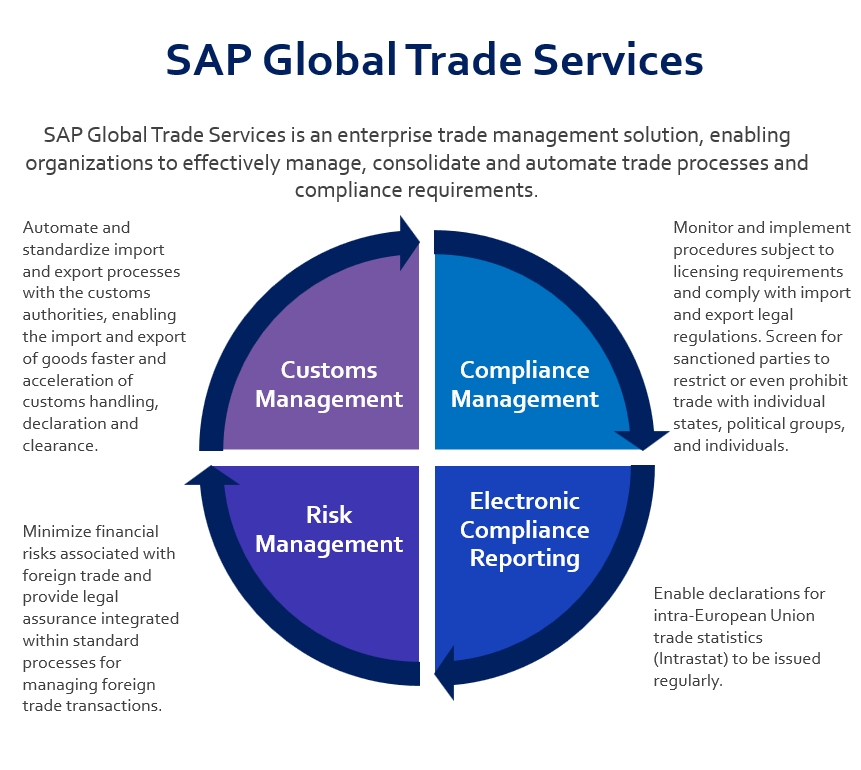
What GTS Covers
Compliance management: Sanctioned and denied party screening, embargo checks, legal control, and export licence determination — with a documented process for reviewing and releasing blocked transactions.
Customs management: Import and export declarations, electronic filing to customs authorities, and the documentation that travels with the goods.
Risk management: Preference determination under free trade agreements, vendor declarations, and letter of credit tracking.
Special customs procedures: Free zones, bonded warehousing, and inward and outward processing relief, where the compliance burden is heaviest and the savings largest.

Built For Where You Trade
The rules that matter depend entirely on where you ship from and to, which is why a generic implementation rarely survives contact with an actual customs authority.
If your trade lanes run somewhere we have not worked, we will tell you that before the project starts rather than discovering it during testing.
UAE & GCC: Free zone operations and UAE customs requirements.
India: GST and electronic filing shape how the system needs to be configured.
EU: We also implement for organisations trading into the EU.
Screening you can't evidence doesn't count.
Under audit, the question is rarely whether you screened. It is whether you can demonstrate that every relevant transaction was screened, against which list, on what date. That is the difference GTS makes, and it is the reason spreadsheet-based compliance eventually runs out of road.
How We Help
GTS implementation: Full implementation across compliance, customs, and risk management, scoped to the trade lanes you actually operate.
Screening setup and tuning: Sanctioned party screening configured with sensible match rules — the difference between a workable system and one that blocks everything and gets switched off.
Product classification: Bringing tariff and export classification into the system as maintained master data, with mass reclassification when rules change.
Customs and electronic filing: Declaration processing and integration with customs authorities where electronic filing is supported.
Free trade agreements: Preference determination and vendor declaration management, so you claim the preferences you are entitled to.
Upgrade and support: Moving to SAP GTS, edition for SAP HANA, and ongoing support once you are live.

Why Vipas

We configure for your trade lanes: Screening rules, classification, and customs setup shaped by where you actually ship, not by a reference configuration.
We work in the region you trade in: Teams across the UAE and India, familiar with free zone operations and local filing requirements.
We stay with you after go-live: Sanctions lists, tariff schedules, and trade agreements change constantly. Support keeps the configuration current.
Get in touch
Tell us where you trade and how compliance is managed now. We'll come back with a view on what GTS would change — no obligation, and no sales pressure.
First name, last name, email, phone, message — that's all we need to start.